Showing posts with label interactive notebooks. Show all posts

Thursday, April 4, 2019

Sketchnoting Resources, Challenges, and Tips

Sketchnoting: visual notes where ideas are conveyed through words, pictures, and visual elements

One of the things I love to do personally and with students is sketchnoting. I realized that while I've been great about sharing my sketchnoting journey, samples, and resources on Twitter, I really hadn't taken the time to make a post here, so it's time to fix that!


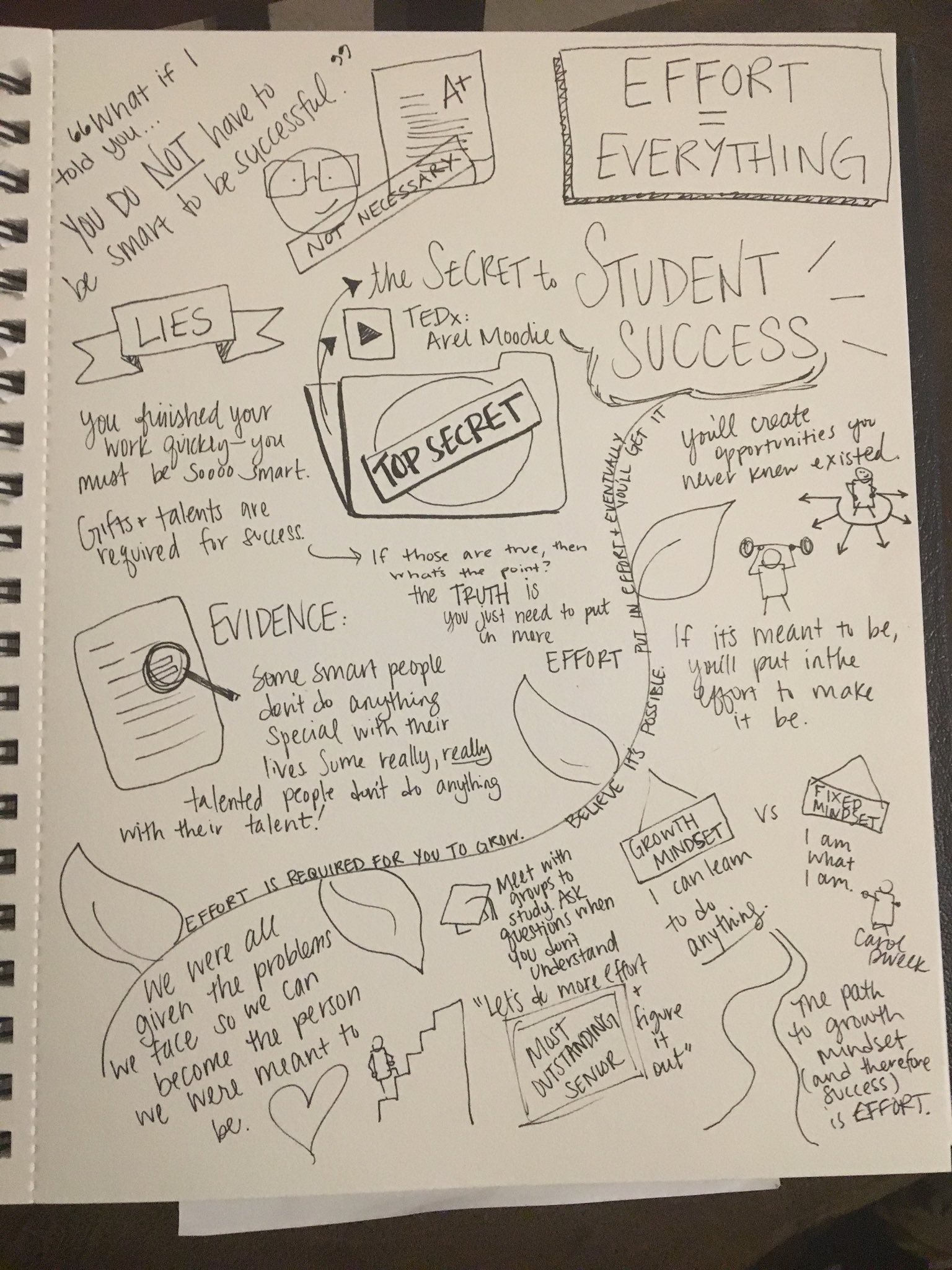
In July 2017, I had the chance to attend a workshop with Silvia Tolisano (@langwitches) on sketchnoting. While I'd heard the term, I only had a vague idea of what sketchnoting might look like. Silvia spoke of documenting learning, making thinking visible, and building connections through notetaking, and I was hooked. Here's my very first sketchnote from that workshop:
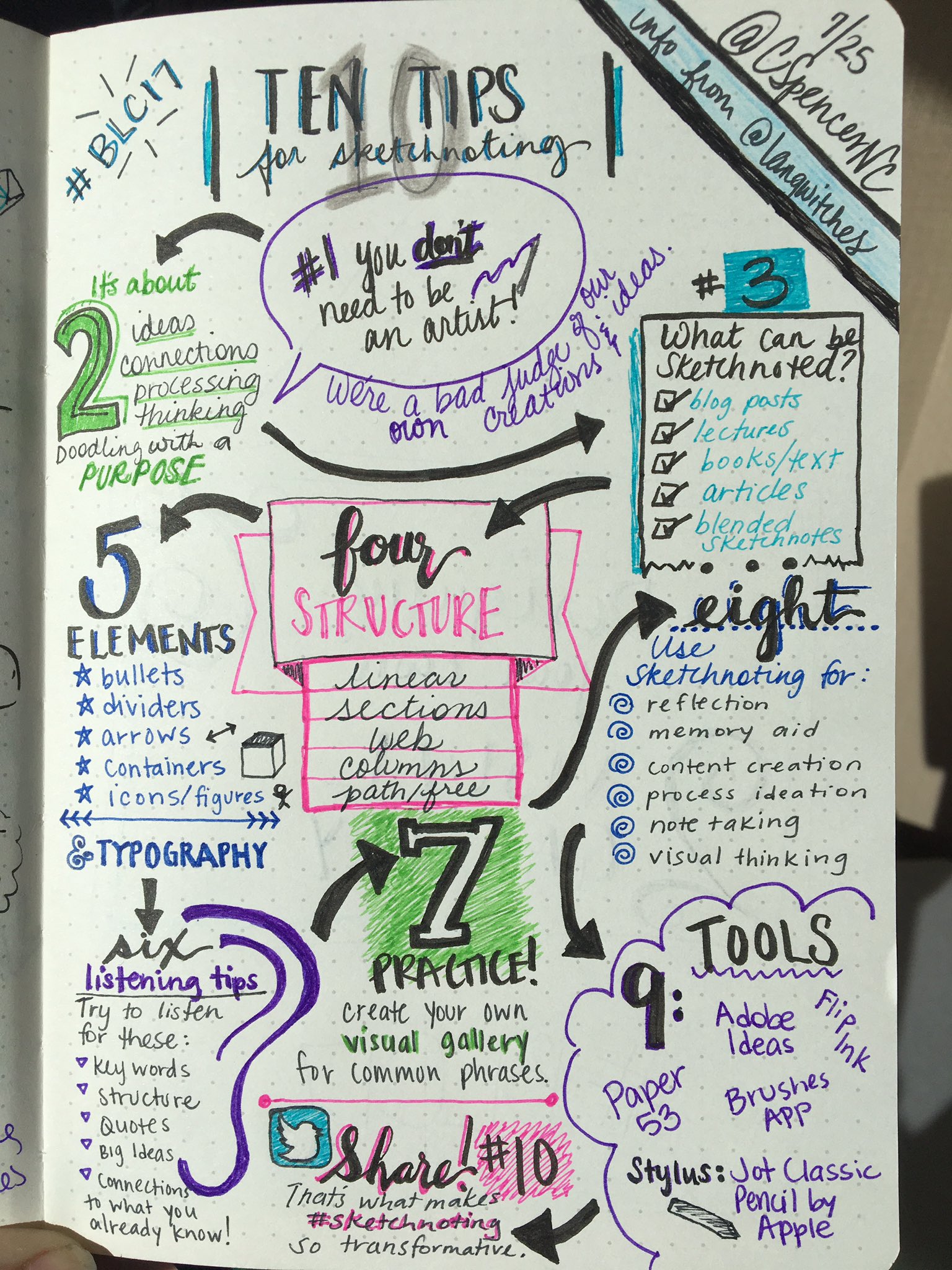

And let me tell you, I was STRESSED the whole way through making it. I wanted to use all of my pretty supplies, I wanted it to be perfect, and I was TERRIFIED of sharing it on Twitter. Since then, I've sketchnoted nearly every conference session, presentation, PD, and keynote I've attended. I've used sketchnoting with students across so many grade levels, and presented on sketchnoting over and over again. 

This technique that I once believed was so much about artwork and perfection...I've come to love it now that I know it's SOOOO not about those things. 


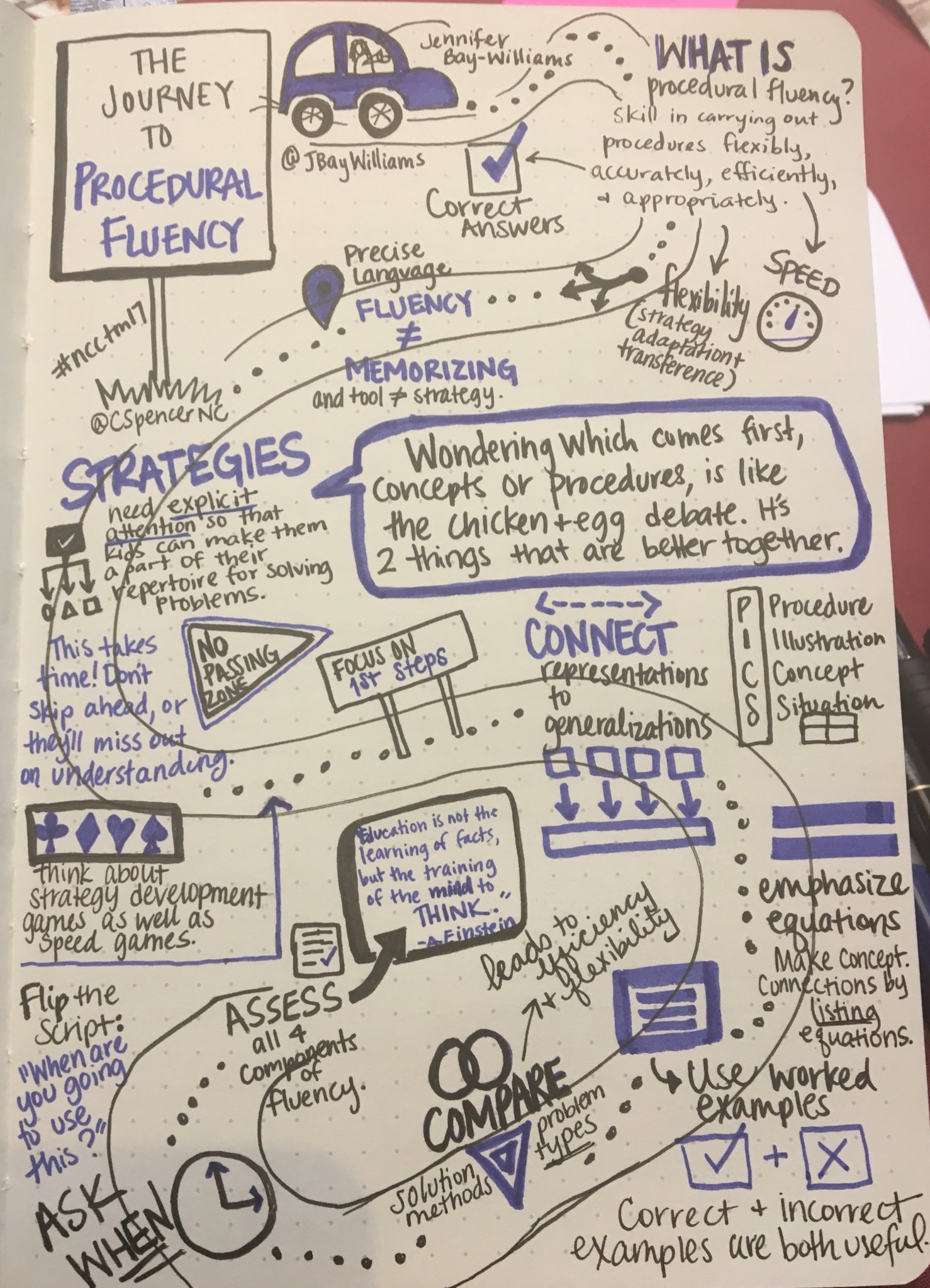
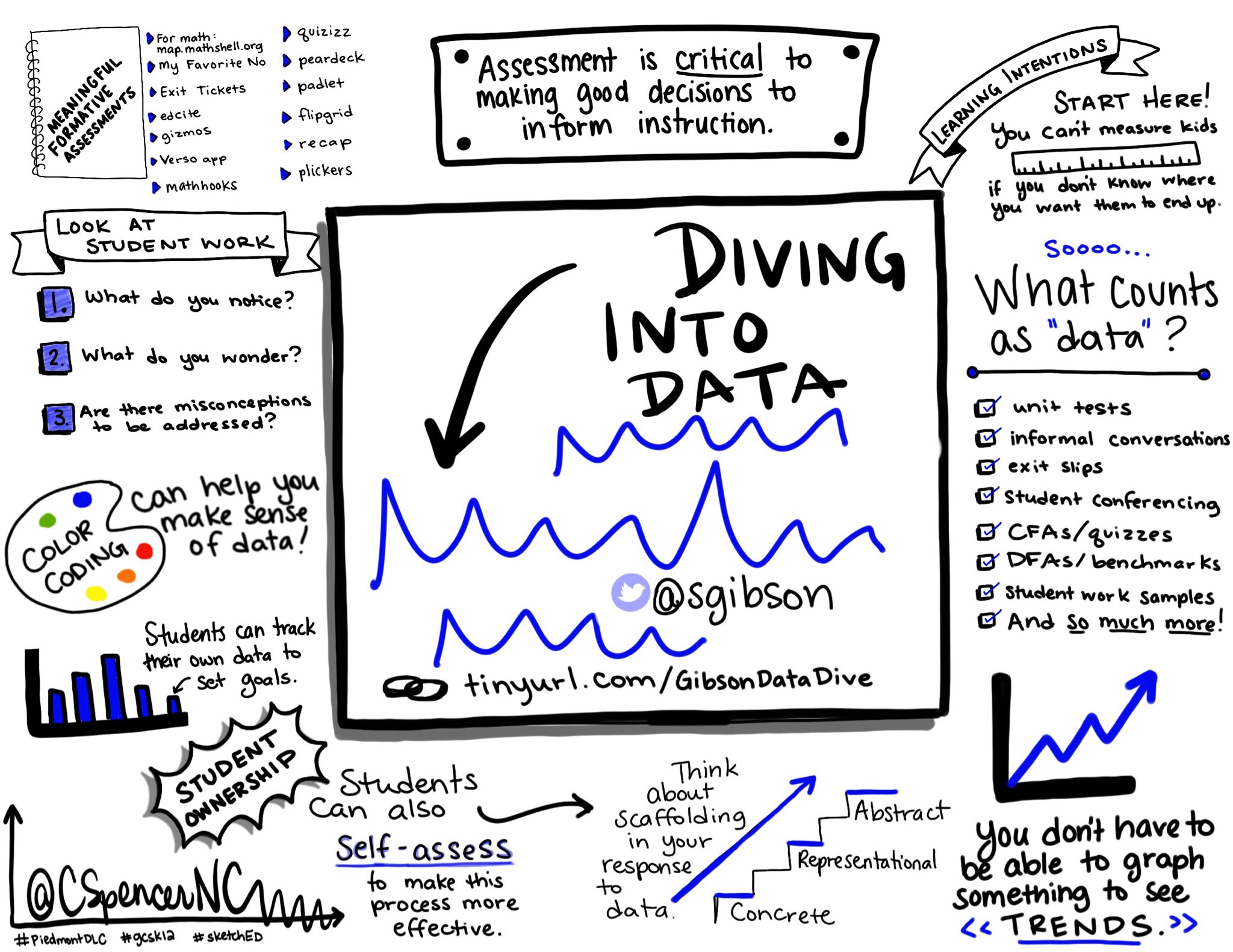
I love that sketchnoting is personalized, flexible, and fun! It lets you show connections and distinctions between different ideas, or rank things based on importance, or separate common content into small groups of information. 

Along the way, I stopped trying to use all of the markers at once:
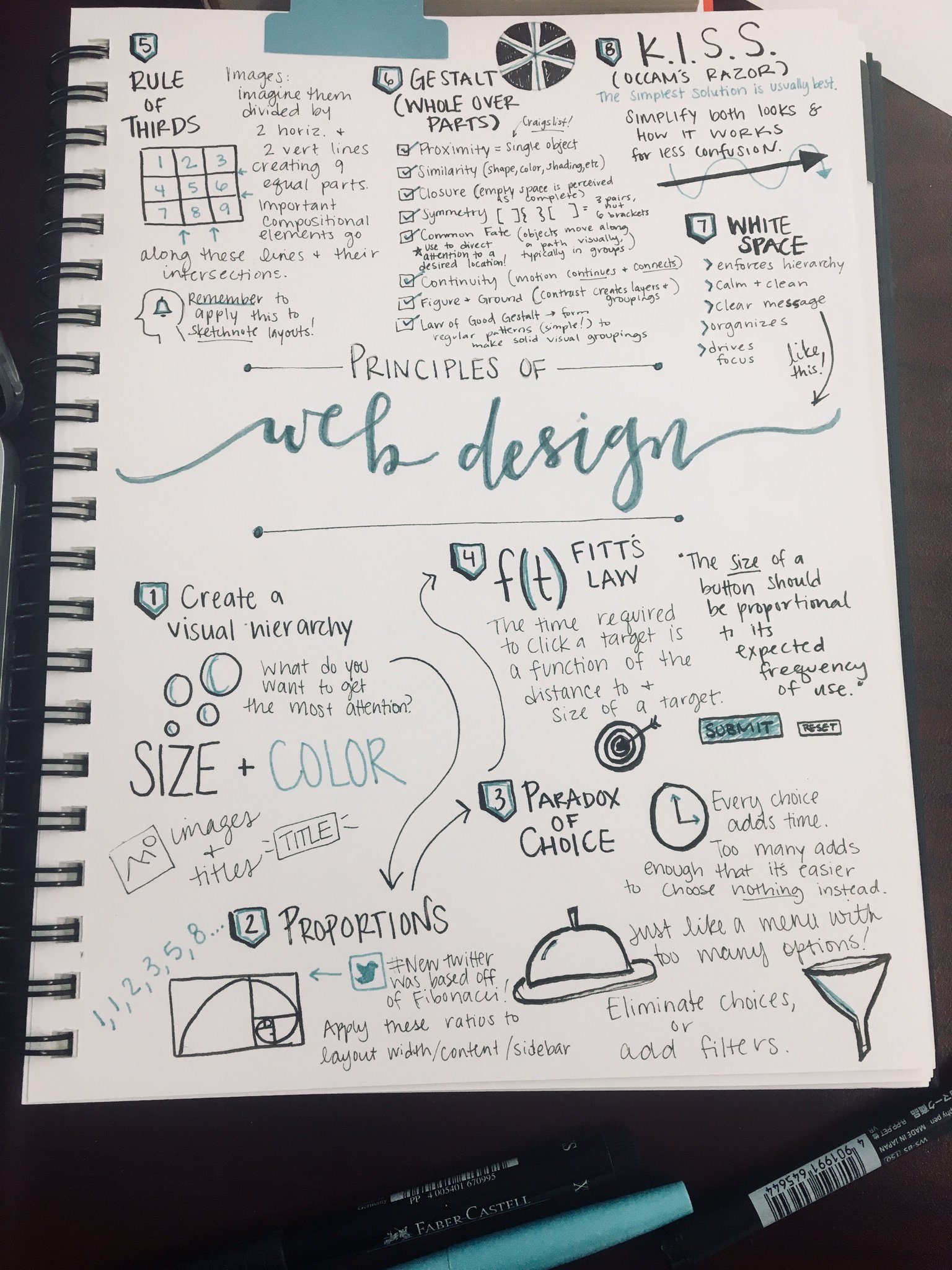


Tried digital sketchnoting...(on an iPad Pro in ProCreate) 



...then promptly went back to paper 😂

And along with a few friends here in my district (especially the amazing @MrsYav), started up a sketchnoting Twitter account to help teachers use sketchnoting in their classrooms and encourage students along the way. It's @SketchnotEDU, and we also have a website where we store our PD materials (bit.ly/sketchnotEDU). 


The Twitter posts aren't as frequent as I'd like, but we do have some prompts and challenges dating back to early 2018. Some of my favorites were the skill challenges, and these remain my #1 tip for teachers trying to support student sketchnoting. 

Each week, pick a skill to work on and to incorporate into your notes. Consider its purpose - what it ADDS to the functionality or organization of the final set of notes, and use that function to guide your decisions of when to use it. 


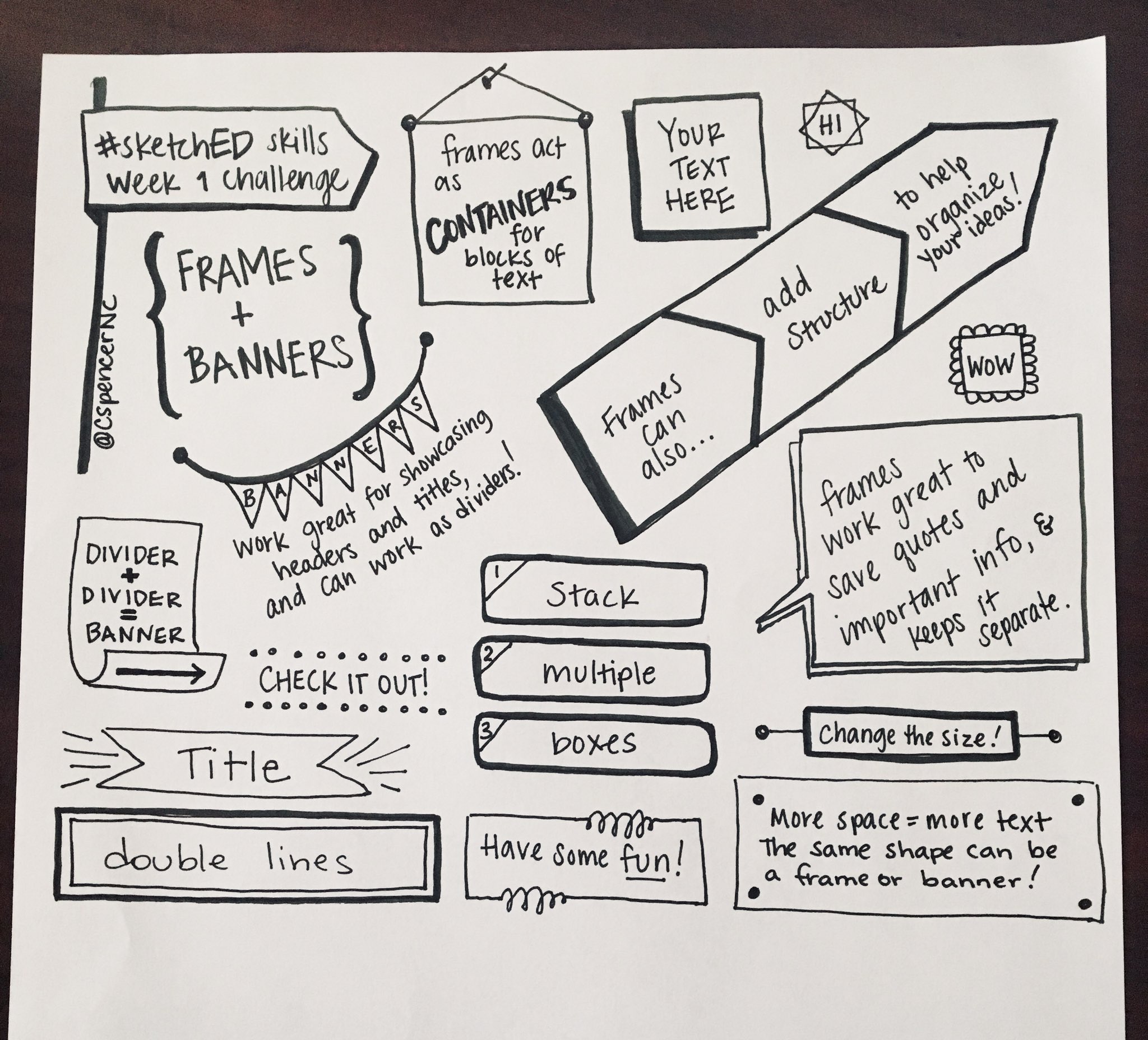
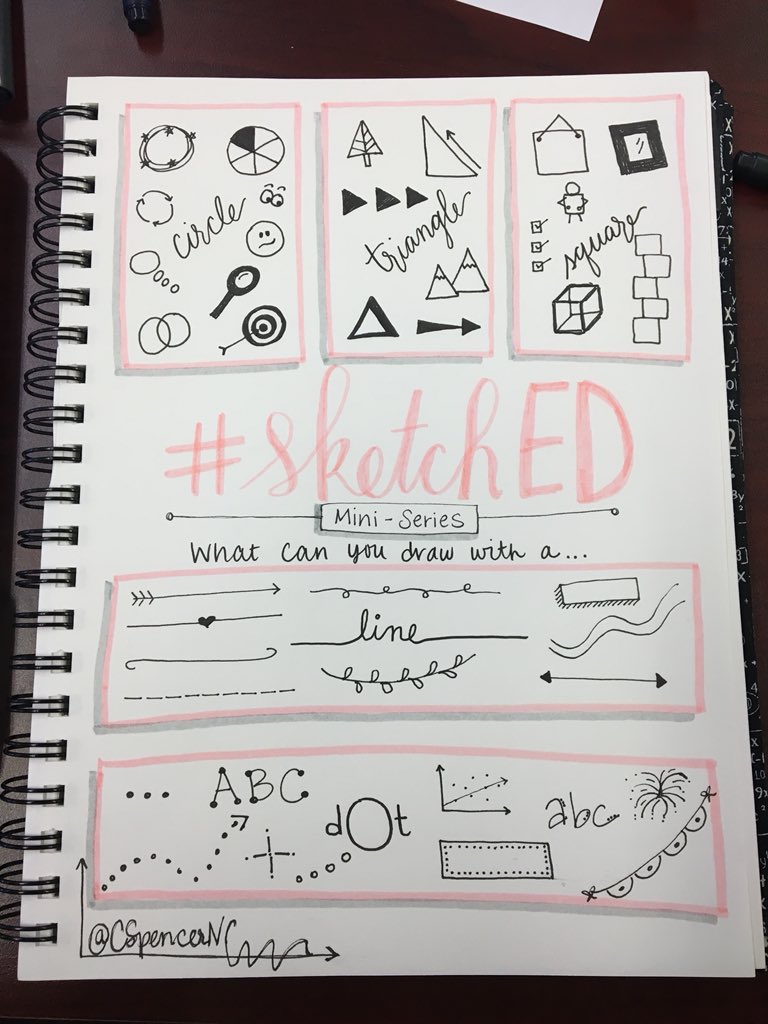
These skills can be specific to sketchnoting, or can still be used with improving students' ability to take notes more traditionally. There's so much value in thinking about WHY bullet lists are useful, or why we might use arrows to connect topics or demonstrate order. Some of the skills challenges we posted on @SketchnotEDU included:

Banners and Frames

And the what-can-you-draw-with-just-lines-circles-triangles-dots-and-rectangles challenge!

There is so much research to support sketchnoting over outlining or traditional notes. I think my favorite thing though is that sketchnotes end up looking quite different for each student, which allows so many opportunities to share, compare, and discuss. 

One final tip, and I'll save the rest for future posts. This is actually for the same reason that I switched back to paper after trying digital sketchnoting, in addition to the fact that research supports paper notetaking over digital notetaking. 

USE PENS. OR MARKERS. DO NOT USE PENCIL. 


While sketchnoting, it's best if we all just forget that pencils exist for a little bit. The problem with pencils is that you've got the option to erase, fix, redo, and repeat. Mistakes are a part of math, a part of learning, and a part of sketchnotes. Sometimes you can turn them into a happy little bird, sometimes you just move on. But using pens or markers instead of pencils will make it so much easier to accept what ends up on the paper, and let go of trying to make everything perfect. 

Friday, May 1, 2015

Skitch Connect Four/Tic Tac Toe with Circle Terms

Hi everyone!

I thought it'd be best to start the first of May off with a blog post left over from April.

We've been starting some geometry lately, and my Math 3 kids really needed a few days to get their brains wrapped around the vocabulary.

I found a neat Circles Tic Tac Toe activity and this blog post including paper folding notes, which helped me plan my instruction for my kiddos.

I've really been trying to put my 10 class iPads to use with partner activities, and this fit the bill perfectly. My class is one of the pilot BYOD rooms in the school, but there's still many of my students that don't have a device to bring. Often, lessons where they can work in pairs instead 1:1 with the tech are much more doable. Here's what we did.

Setting up an ISN page that's got several pieces can seriously EAT class time. So I replaced their usual warmup activity with some simple instructions. I had the first 3 people in the room pass out the strips of paper, which were 1/3 each of a colorful letter sized paper.

We worked together to fill out the index cards, talking about what they knew, and the importance of certain distinctions (line vs. line segment, etc).

We also separated their cards into three groups (the idea I got from the post linked above). 

We practiced using some task cards and a game of Scoot. 
Then students were sorted into pairs, and each pair needed 1 device. 
I posted the picture file in Google Classroom, and they opened it using Skitch. 
(If you don't have devices, you can also print & copy one per pair, or laminate and reuse with dry erase markers.) The Slides file with the instructions and complete list of vocab is here

The picture file that my students used looked like this:

They used the Skitch app to draw their X's and O's on the board. 
Below is what the board looked like after one pair finished a game. 

The tech allowed us to save some paper, play multiple times, save the results, and have a bit of fun!
My students enjoyed the activity, and I appreciated the 5 minutes that it took to create this activity. I'll definitely be using Skitch for ed games again soon!


Friday, October 17, 2014

Daily Quizzes - An Easy Way to Start a (kind-of) SBG System & Provide Classroom Incentives

I want to share the biggest change I've made to my classroom this year: Daily Quizzes. 
This is the brain child of one of my amazing colleagues. Last year, he did 6 question exit tickets as a homework replacement. YES. A math teacher that assigned NO HOMEWORK. 

Well, I wasn't quite ready to take that leap. However, I did like the idea of having plenty of skill-based data reports, and tying it to an incentive. So we decided as a PLC to compromise. DQs emerged from that compromise. Here's how it works.

Each day, after notes, students have around 15 minutes to start their homework. (We have 90 minute blocks.) After that initial practice time, I project a 6 question quiz on the board (My PLC creates these together ahead of time). 
Students are allowed to use their notes. Once they're finished, they bring it up to me, and I grade it immediately (It takes less than 15 seconds per quiz. I use open ended questions, and there's no partial credit. Each is right or wrong, and I spend no time at that point looking through work or evaluating mistakes.) I record their score, tell them, and keep the card (which helps keep the answers from traveling around the room). Here's a picture of my recording sheet:

The topics are along the top, and scores range from 0-6. I do give half credit VERY rarely for students that made arithmetic errors, or for answers not in best form (such as answers with negative exponents). I color code the scores at the end of a unit, on the morning of the review day. This helps me remember where our weaknesses were throughout the unit. 


0-1 are red
2 is pink
3 is orange
4 is yellow
5-6 are green
Absent is blue - I don't typically require students to make these up.

You can see the clear difference in my honors classes (above) and my regular class (below).


Another difference between honors and regular classes is the number of questions, and incentive attached. Honors classes get 5 question DQs, and students that score a perfect 5 are permitted to complete every other homework problem that's assigned that day. Regular classes get 6 questions, and students that score a 5 or 6 get to only do half the problems. 

This homework incentive has been FANTASTIC. Students take the notes seriously, because they know they're going to want to reference them during the quiz. They work furiously during that initial practice time, and even my withdrawn/shy kiddos will reach out to their group or to me to ask questions to iron out any issues during that time. 

After they get their score, they resume work on the homework assignment. I typically reserve around 20 minutes for the DQ, which means the early finishers have around 15 minutes to work in addition to the 15 they already spent. As much as they hate getting 4s, they get so competitive about the 5s and 6s. We had to start a class vs. class competition - and I think adding an extra question for my regular class puts them on a level playing field. 

Class DQ Board: 1st Regular, 2nd & 4th Honors
I go back once everyone's finished and look through work. We clarify common issues, and I give cards back so students can post them on the bragging wall (shown below), or look over their mistakes. 


Let's talk about some details on logistics:

Grading: I grade these as a single quiz grade per unit. I drop the lowest one from the unit, then average the rest. The percentage for the average out of 5 is their grade. (For the regular class, this means that they could get a quiz score over a 100 for their 6s. I haven't had an average over 102 yet this year, so I'm not concerned about giving them a few extra points for a 6. I make sure that the questions are difficult enough so that 5s and 6s aren't guaranteed.) These have completely replaced normal quizzes for me, and I'm ok with that even though they're all open note quizzes.

Supplies: I have students bring in index cards to turn in at the beginning of the year. These are in the supply bins for their groups, and most of the time we use them to complete DQs. Occasionally, they prefer using a piece of notebook paper instead, especially for problems that take up a bunch of space. 

Student Data Tracking: Students keep up with their own scores in 2 places. 
They record the score first on a page I created to go beside their Unit TOC page (from Math=Love). 
This score goes right beside their homework assignment page number and homework grade, so I can quickly check their scores as I grade homework. This means I know whether to give a 50% or a 100% for a page that has every other problem completed. They get a stamp on this page and on their punch pass for each 100%. (My blog post on punch passes is here.)


The second place they record these is at the beginning of their Reference & Warmup notebook (post on my new notebook setup is here). They record a daily I Can sentence from the board, with the corresponding page number, their DQ score that matches, and fill in a bar graph beside it. I encourage them to use this right before their test to reflect on what to spend the most time studying.

My regular students have 6 boxes, since they can score up to a 6.
 
My honors students have only 5 boxes.
As you can see, some students are a bit more colorful with their records, and there are days we run out of time for a DQ.
I have also done "Daily Double Quizzes" where we do a makeup DQ from the day before along with that day's regular DQ.
Also - note the frowny faces. They HATE getting 4s. 

I post the entire week's I Can Statements at once on the front whiteboard.

I'm painfully aware that this system is missing a couple of things: a method for reassessment, make-up DQs for absent kids, and a way to tie this info with their tests. However, it's also been the easiest transition to something close to SBG that I've ever implemented. I've been able to save time grading too, which is always great. 

Enjoy your weekend!


Monday, September 1, 2014

2014 ISN Setup

This year, I have completely changed how my students are doing interactive notebooks. 

Each student has 4 1-subject notebooks. The first will be used all semester, and the other 3 will be used for each of the 3 grading periods. The notebook for each grading period will be used for homework and notes, and the notebook that will be used all semester has 5 sections for Daily Quizzes, Formulas & Reference, Vocabulary, Review Questions, and Warmups. 

Here's the 1st 6 weeks Notes ISN setup so far:

  • Title Page
  • Math Notebook Rules
  • Unit 1 Table of Contents Page
  • Unit 1 Notes & Homework


We're using the unit TOC from Math=Love found here. Beside it is their homework log and Daily Quiz scores, which will be signed and collected at the end of each unit. 

For the Reference ISN, the first 4 pages look like this:
They fill in a daily I can sentence, and the page number to match. Then at the end of class, they fill in their Daily Quiz score to the right (It's my new modified SBG system - more info to come soon). 

The rest of their notebooks is divided up into 4 sections as mentioned above. Each section has a tab, and a purple page header as shown. We'll be using them throughout the semester for general reference and warmups. 

I really like separating these sections from the notes and homework by putting it all in a separate notebook. While some students took a few days to catch onto the routine, by Friday this system was working like a charm. It also lets me grade their warmups while still allowing them to bring their notes home. 


Sunday, August 31, 2014

A Quick Update & Summer PD Links

Well hi!
It's been a long summer, but quite a lot has happened in the meantime. 
Here's a run-down on the personal stuff that's been going on:

  • I spent most of the summer working on creating PD sessions. (Links to follow below)
  • I also worked for my county on a technology team and a curriculum team. 
  • Every other spare moment was spent quilting. *Sigh of bliss*
  • My husband and I spent time converting the guest room into a sewing studio.
  • I got a new job (EEEP!) on weekends teaching quilting classes. (I'm Sew excited! HEHE)
  • 2 weeks into having a sewing studio, I found out my sister would be moving in with us. She got a job in NC in the same county as me teaching 5th grade, so she moved up from Florida on a Friday just in time for the first workday the following Monday!
  • And of course there has been plenty of room decorating and resource finding over the summer. 
Whew! I've had students for ONE FULL WEEK now, and I (almost) forgot how FUN getting new students is. I love it. 

Ok. So let's cover a couple of quick links I've promised first. 
Here are the links to Livebinders I used to present at PD sessions over the summer:
While we're busy linking up to resources, have you found me on Pinterest? Most of my brainstorming and resource collecting happens there. Follow me to see and share what I find. I also post all of my interactive notebook through Evernote each year. Here's the link for my Math 2 notebook this year. 

This year, I was also fortunate enough to begin participation in a technology team, which means I get 10 iPads just for my room this year! I'm so excited to start using them with my students. 


Monday, June 16, 2014

ISN Setup for next year

I've been sitting in PD all day now - and as a natural result, I've been thinking about what to do differently for next year. The PD is for a technology team that I applied to, and I'll be getting 10 iPads for my students to use for participating.

A couple things I know about what I want for next year:

  • Increased use of centers, stations, and collaborative activities
  • Continued use of the interactive notebooks
  • Increase student accountability for the standards-based assessments (retesting requirements)
  • Better spiraling of review topics, especially with warmup questions
I think I'm going to switch my ISNs to be 5 subjects. For the past few years, I've used 1-subject notebooks (1 per grading period). This past semester, I also had the students count out the last 15 pages to use as a warmup section - which I LOVED. No more answering "what page does the warm-up go on?" when I forget to write it on the board. (Or, let's be honest. I still answer that question a few times even when the answer is written on the board.)

For the fall, I'm finally going to switch to a 5-subject notebook. We'll use 1 subject for each of the 3 grading periods. The other 2 subjects will be for warmups and grade tracking/standards based assessments/EOC review.  

I'm looking for a good way to track homework as well - at this point, unless one of you send me an awesome idea, I'll have a modified reading log taped to the back cover that will show their homework grades for the entire semester. My goal is for them to be able to see their homework grades right beside their unit test grades (in the hopes that they will realize how much completed homework helps their grades). 

Break's over - let me know if you have any great ISN ideas for me. I'll post more over the next 2 weeks as I hear great ways to integrate technology when I get through all of these PD sessions. 


Friday, May 2, 2014

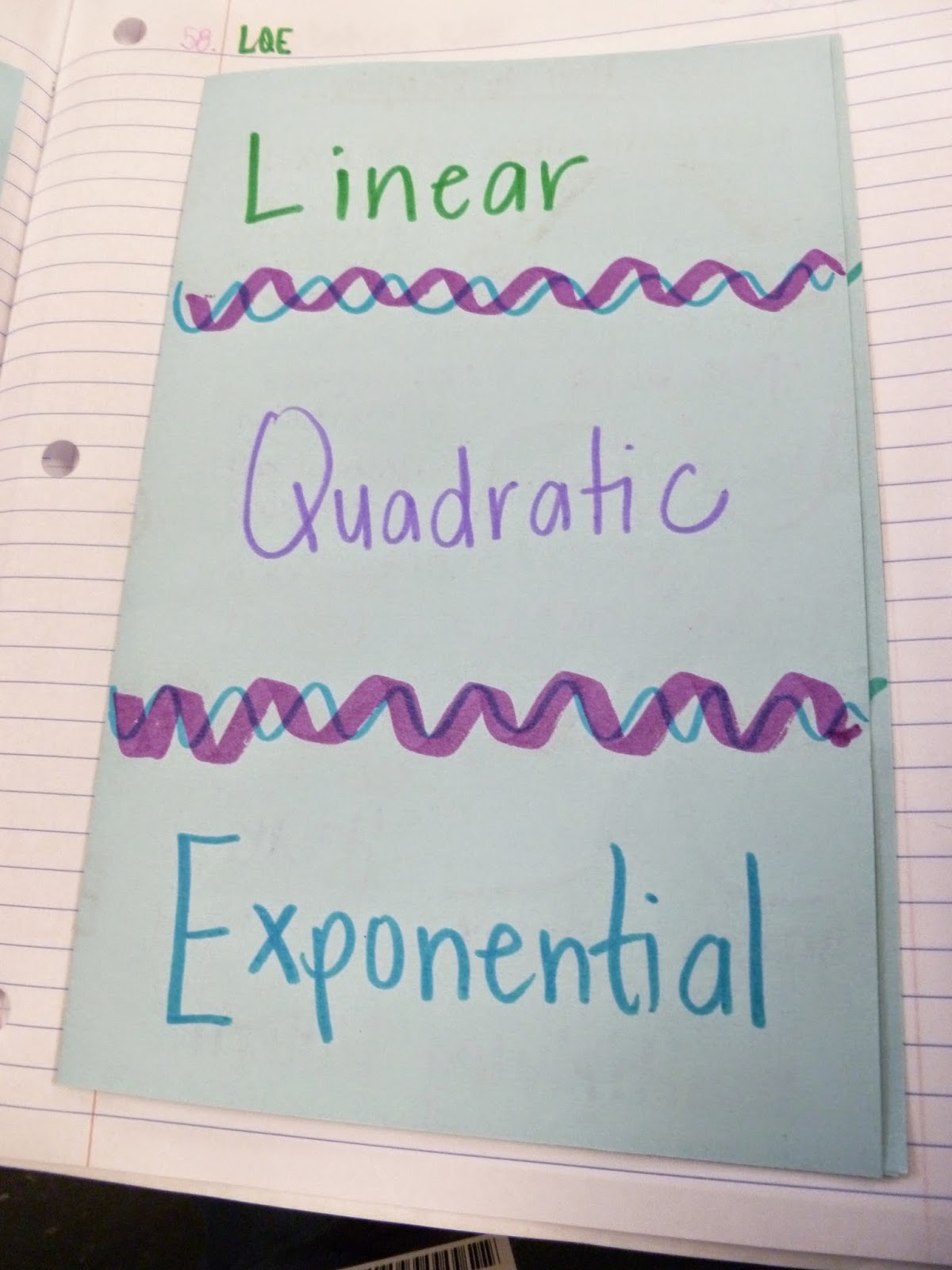
Friday Freebies! Comparing Linear/Quadratic/Exponential Functions

My students are testing today on the unit we introduced with Zombie Day


We used a "Fun with Functions" Cut and sort activity to practice identifying/classifying LQE functions.
 We spent plenty of time working with multiple representations of each, and how to write the equation for a function once you know what type it is.

Then we moved on to translating, with matchbook notes. 


And after seeing this blog post from Math=Love, we included a drawing of our calculator yesterday when talking about using the regression functions on our Ti-84s. 

And we practiced, and practiced, and practiced. 
We did a scavenger hunt.


We used LQE cards on the 2nd day of the unit for whole-class response practice. 

The following day, we increased the level of difficulty by using cards that said what type of L,Q, or E each example was. (The exponential card had decay on one side, growth on the other)

I wanted to do so much more with this unit, but there's only so many days left until testing season begins.
However, I do think that having a day of centers would have been better than only doing the practice in mostly whole-class settings. So I made a card sort for this unit (using this 12-block template) - we'll use it for EOC review. I wrote up the process for using a similar 9-block template in this previous post.


Here are some of the ways I'm thinking of using the LQE cards (it's a set of 48)
  • printed 2 to a page, into a column sort in their ISN
  • printed onto cardstock, used as Go-Fish or Memory (each exponential matches with any other exponential)
  • printed onto cardstock, used as a center matching activity (3-column sort as a group onto a posterboard or table marked with 3 sections)
  • center activity where students play Left-Center-Right, but to keep/receive a card, they say L/Q/E
Start the download for the card set by clicking here. It's a Word docx file, so feel free to edit it to suit your students' needs. 

Have a great weekend!

Wednesday, March 19, 2014

Scavenger Hunts - and a free template!

I've truly had a very productive week this week. I am ahead in planning, and spent some time yesterday creating a template that I'd like to share. 

I don't know who came up with the idea of this type of scavenger hunt, but I use them ALL.THE.TIME.
At least once per unit. Usually more. 
Because a 10 question scavenger hunt takes me 5-10 minutes to create, and lets them practice with or without partners, usually filling up 15-30 minutes of class time. 

I have so many of these that I've handwritten. In my teacher bag, I even carry around "scavenger hunt packets" of  sets of 10 different colors of cardstock. When waiting for a meeting, it's so easy to quickly make a set of these from 10 questions scrawled out on a scrap of notebook paper.

Just in case you call them something different (or haven't heard of them), for a scavenger hunt you post a number (I typically do 10) of questions and answers around the room. You can see them posted in the picture above - a blue one on the wall, a pink one on the window. 

Each page has an answer on the outside and a question on the inside. This set was for multiplying polynomials.


Each page also has a letter to label the question. 

Students start at any question, work it out on their paper, and then search for the answer on another paper around the room. Once found, they complete the question under that answer. After they've completed the last question, that answer brings them back to where they started (which is why they can start at any letter). 

I have students work their questions out on a piece of construction paper set up with the same number of boxes as questions. They put the letter that they are working on in the smaller box. The letter sequence (which is always random) allows me to quickly check their work while I'm circulating around the room. Once complete, they attach the page in their ISN.


This is what the cards look like stored for future use - I write the answer key on a sticky label and always stick it to the back of the A card, with the topic and number of questions. When I'm ready to use a set, I quickly copy those 10 letters onto a post it which I keep in my pocket for the day.

Here's how I keep the scavenger hunts (and all other game/station activities) organized for future use:
I have 2 large milk crates with hanging files labeled by topic. 

Each activity is inside either a bag, sleeve protector, or binder clipped. 
As you can see, I'm still working on finding more activities for several of my algebra 2 topics. 
This is NOT where I keep worksheets/foldables/ISN pages. 

These bins are only for games and station activities. This is also where I keep flashcards, task cards, and non-content specific TPR materials (Yes/No cards, worksheet game boards, ABCD cards/etc.)


So back to the scavenger hunts, and on to the freebie!
I decided that I wanted a way to type these so if I'm on the go, I can quickly type up a set of questions and answers in Evernote, and then just copy and paste right before I print. So yesterday, I sat down at my laptop and made it happen.

I made a template in Word that will automatically populate a 10-question set of questions and answers. 

AND HERE'S THE AWESOME PART. 

Because of the way I have it set up, you can even use pictures/equations/screenshots for your questions or answers! Yes, that's right. You don't have to type in questions - use the snipping tool, or a web clipper like Lightshot, and it'll be done in 5 minutes, ready to print. 

Instructions are in the file - click here to download it

(And if you create a set for something algebra-ish, please send it my way! 
If you need help using it, email me or have the MS Word teacher at your school look at it - the file uses cross-references to bookmarked cells in the table on the first page.)

I am really so excited to start using this template - once I've made a few sets, I'll share them as well.