Showing posts with label linear functions. Show all posts

Friday, May 2, 2014

Friday Freebies! Comparing Linear/Quadratic/Exponential Functions

My students are testing today on the unit we introduced with Zombie Day. 


We used a "Fun with Functions" Cut and sort activity to practice identifying/classifying LQE functions.
 We spent plenty of time working with multiple representations of each, and how to write the equation for a function once you know what type it is.

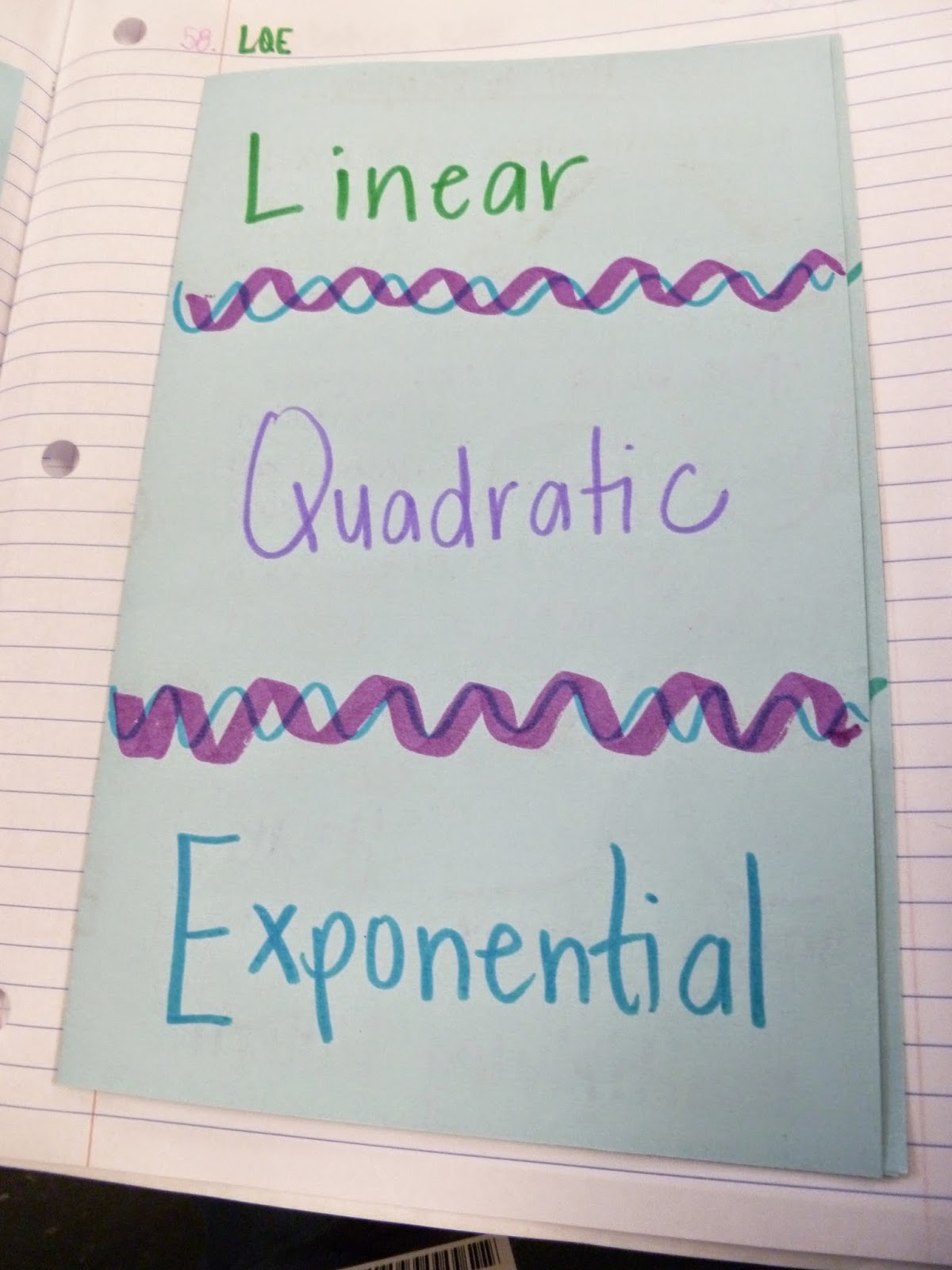
Then we moved on to translating, with matchbook notes. 


And after seeing this blog post from Math=Love, we included a drawing of our calculator yesterday when talking about using the regression functions on our Ti-84s. 

And we practiced, and practiced, and practiced. 
We did a scavenger hunt.


We used LQE cards on the 2nd day of the unit for whole-class response practice. 

The following day, we increased the level of difficulty by using cards that said what type of L,Q, or E each example was. (The exponential card had decay on one side, growth on the other)

I wanted to do so much more with this unit, but there's only so many days left until testing season begins.
However, I do think that having a day of centers would have been better than only doing the practice in mostly whole-class settings. So I made a card sort for this unit (using this 12-block template) - we'll use it for EOC review. I wrote up the process for using a similar 9-block template in this previous post.


Here are some of the ways I'm thinking of using the LQE cards (it's a set of 48)
  • printed 2 to a page, into a column sort in their ISN
  • printed onto cardstock, used as Go-Fish or Memory (each exponential matches with any other exponential)
  • printed onto cardstock, used as a center matching activity (3-column sort as a group onto a posterboard or table marked with 3 sections)
  • center activity where students play Left-Center-Right, but to keep/receive a card, they say L/Q/E
Start the download for the card set by clicking here. It's a Word docx file, so feel free to edit it to suit your students' needs. 

Have a great weekend!

Tuesday, April 29, 2014

Zombie Outbreak!

One of the topics I've started teaching since NC started Common Core is comparing linear/quadratic/exponential functions. Two semesters ago, I saw this blog post where a teacher had used zombie outbreaks to have students explore exponential growth.

I switched up the lesson plan a bit, and we did 3 rounds of "zombie outbreaks" in my class, each with a different soundtrack. At this point in the semester, we've learned about linear, quadratic, and exponential functions. However, I don't tell my students which outbreak is which until we're done.

For each round, students meander around the room, and my "patient zero" student follows the rules for that round by infecting students in a certain way. (Infections are stickers on their hands). As we listen to the music, I announce every 15 seconds "End of day __, Wake up, everyone! It's the morning of day ___!" I make a big deal of everyone "freezing" at the end of the day to "sleep," and then we resume movement with waking up on the next day.


  • Round 1: (Linear) Each day, the zombie "infects" 3 new people, but the new zombies cannot infect anyone.
  • Round 2: (Quadratic) Each day, the zombie learns how to infect an additional 2 people per day (I tell them the zombie is learning to run faster each day, and so the first day is still 3 people, but then 5, 7, and so on). New zombies still cannot infect anyone.
  • Round 3: (Exponential) Each day, every zombie is able to infect 1 person. New zombies have infection powers.


It's so funny to watch them play this - I always have a couple students that want to be infected, and a couple that don't, and run away from the zombie. The game usually turns into a mild game of tag/hide-and-seek.
Once infected, the students have to "report their infection to the CDC," which means dragging a picture of a person on the SMARTboard into a box for day 1, 2, 3, 4, 5, or 6. (whichever day they got infected).


Once the rounds are complete, we record our findings in our ISNs, and discuss what patterns we see. Usually my students identify round 1 and 3 almost immediately as linear and exponential. I also usually have 1-2 students that see the square number pattern as well, which leads us to label round 2 as quadratic.


We discuss the characteristics of each function that we remember (this is a great review right after spring break), and then write the equation for each round. Then we destroy the world. :)

They research in groups online to find the population of our school, city, county, state, country, continent, and the world. Then they solve for round 1 and 2 how many days it would take to infect that population. They use a guess and check method for exponentials, since Math 1 kids don't learn logs until next year.


Things I want to improve in the future:

  • predictions about each round before we start (I want them to discuss which scenario will infect the most people in a week, in a year, etc.)
  • "CDC Disaster Reports" as a lesson conclusion (I'd love each group to take 1 time period, maybe a week, 1 month, 6 months, 1 year, and write up the infection rate based on each scenario)


Tuesday, March 18, 2014

How to make a stations activity in a hurry

Hi! 
So we've had quite the busy semester so far, but my focus this semester has been to develop interactive/cooperative learning fun stuff for my Math 1 kids. I moved schools last year, and my old school had a department-wide bin of games. There weren't many in it, but it was nice to know at the beginning of the unit that I could take the folder for that topic and instantly have a couple of really good resources to use. I've made it my mission as math department chair at my new school to recreate that setup, with electronic files, interactive notebook pages, and games/stations activities. I currently have 2 milk crates filled with games and activities sorted by topic - I'm going to try to share as many of these as possible.

One of the things I recently started planning was my professional development session this summer on making your secondary classroom more engaging. With the help of a couple of AMAZING coworkers, I'll be presenting sessions on interactive notebooking, using games and centers with secondary students, and how to help students track progress with skill-based assessments (basically, my version of SBG).

As I wrote up the documentation needed for the PD for games, I realized that while I have created plenty of different activities, I don't have electronic versions of very many. The reason for that (as well as the reason I'm willing to create them) is because I can create enough of these types of card games to have a set per group in my class pretty quickly. The reason it's so quick is because I use a test generator or Kuta to print the questions, and then physically cut and tape them onto a pre-made template. 

That's the process I want to share today. 

First, print out a worksheet answer key, test with answers, or KUTA page with answers. Double the number of questions to determine the number of cards you'll need to make.


You'll need the card template (shown is a 12 card template - I've since switched to 9 cards, since they're a bit easier to play with.) Download the card template by clicking here. Print out enough of them for the number of cards you plan to make.  You'll also need scissors and tape. 

Cut out each question and answer separately. No need to worry about keeping anything in order. Don't worry if the edges aren't straight. This is where I love using KUTA worksheets - everything's aligned, and I just cut out the columns then snip it apart. Tape the pieces onto the template, one per box. They don't have be perfectly straight. I also typically lay out a page, then tape them all at once with larger strips of tape, rather than tiny pieces on each box.

I'd like to take a moment here to mention that if you're feeling ambitious, you can cut and paste screenshots of questions/pictures to use, or you could type in the template. I typically don't do that only because it takes 5 times as long to make the same type of game, and it still looks typed and neat when done this way.

Once you've got them taped, now's your opportunity to scan the page to save an electronic copy, or copy it for a neater hard copy. 

Copy your pages onto different colors of cardstock - I use a different color for each set, so if a card goes missing it's easy to figure out where it goes.

Cut apart the blocks by following the guidelines on the template. Using a template without lines around the edge not only saves cutting time, but also ensures that every bit of the page is used - no waste!
I use a large craft cutter from Michaels. Use a 40% off coupon and a teacher discount of 15%, and they're quite reasonably priced! 


Put each set into a snack or sandwich size baggie.

Put all baggies into a gallon size bag labeled with the topic, activity description, and number of sets of cards.
 

And that's it!
You now have an easy game card set that can be used as a matching activity, go fish, old maid (if you leave one card space blank per set), memory/concentration, etc. This same deck can act as any of those games, and can be reused again and again. 

Here's the scanned copy of the set I made:
  matching linear equations with their graphs. 

Enjoy!
(By the way, if you have ideas for other fun activities/games that you use in your classroom that work across different content areas, please share in the comments section. I'd love to include them in the PD session over summer, so that other teachers can make their classrooms more engaging for their students.)