Showing posts with label freebies. Show all posts

Thursday, July 23, 2015

Playing SPOONS in Math Class: Ideas, Template, & a Download


I saw a tweet today that really got me thinking. It leads you to a game of SPOONS with equivalent fractions and the directions to play the game, in case you've never played the card deck version.  #TMC15 is happening, and I'm at GCS Pinnacle feeling a bit left out of the fun. So when I saw this, I knew I had to whip up a batch of cards. 

Pinnacle's topic of the day is Gamification/Gamed-Based Learning (turns out, those are 2 different things). This morning, we played Minecraft, learned about the SERIOUS educational potential there. I'm still pondering if there's something I can use for upper level Secondary Math. Comment below if you think of something. In the meantime, I'm content to see its value for other content areas, particularly in MS Social Studies/History. We ran through WWI and colonization simulations this morning, and it was powerful, even for adults. VERY COOL STUFF. 

This afternoon, our assignment was to create a game. I'm always on the lookout for new games, but I haven't created very many. So it seemed more productive for me to take this new (to me) idea, and make it useful for my grade level. 

Step 1: Create cards. Click here for my 9-card template, which creates 9 playing cards from every sheet of cardstock. Most of the time, I copy this onto cardstock, cut apart, then write on the cards. Occasionally, I'll type up a batch. You need 4 cards per player (I'm planning on groups of 4-6) with a few (4-8) extra. 

Step 2: Decide on a topic. Spoons is fast paced. It's perfect for skill-and-drill type questions, or at least topics that can be identified/classified/etc. quickly. 
Here's the list I can think of off of the top of my head (feel free to add more in the comments!) You will need 4 components/equivalent forms to match up. 

  • Linear equations (matching slope/y-int/table/equation)
  • Linear equations (multiple forms - words/table/equation/graph)
  • Exponent Rules
  • Quadratic equations (matching vertex form, vertex, graph, & ??? )
  • Simplifying radicals (perhaps matching like radicands)
  • Circles (matching equation, radius, graph, and center)
  • Transformations (1 equation w mult. transf., other 3 cards have transf. )
  • Factored form of polynomial & roots, maybe with # of real roots/# complex
  • Exp. Growth & Decay (situation, equation, % rate, growth or decay)
  • Parallel Lines & Transversals (match up 4 examples of alt int, etc.)
  • Triangle Congruence (match up 4 examples of SSS, etc.)
I'm sure there are lots more. Typing this list, it occurred to me that ALL of these would be great post-it activities as well. (Need a reminder about that? Check out this post.) I need to do a better job this year of allowing students to get some practice in a non-worksheet way. 

My friend @sgibson and I wrote up this set for linear equations pretty quickly. 


I typed out a batch of simplifying square roots - students would simplify mentally, then match up based on the simplified radicand. An answer key/master list is included! It took me about 20 mins. from start to finish - not too bad for a new activity! Click here to download it. 

To wrap up, here's my Top 10 take-aways from #GCSPinnacle this week:
1. CANVA is amazing. I've used it 10+ times in 2 days. LOVE. 
2. Badges work. If adults love it, so can high school kids. 
3. It's hard to find teaching techniques that work for all content areas. Some just won't. And that's ok. 
4. Sitting in a desk every day is NOT any easier than teaching. It takes serious personal motivation to stay focused. 
5. There's not a gazebo in McAdenville anymore. There IS one 5 seconds from the Rader Center. 
6. People get goofy after sitting in the same room for 4 days straight. 
7. I need to be on Twitter more. #ILiketoHashtag
8. I need to share more, and worry about having "finished products" less. 
9. You can accomplish a LOT of planning when you're not focused on 1 topic (like what's happening next week, or tomorrow) but rather on an entire course.
10. Cutesy activities usually make me wince, but they really do build a sense of teams. (Shoutout to People Machines & our toaster!)


Tuesday, July 21, 2015

Review Fun: How to Play the Dice Game


This great, low-prep, EASY review game was shared with me by my classroom neighbor. He heard about it from a friend at his last school. Who knows where this game has its roots?!

SETUP:
  • Game template file (Download it here) on SmartBoard
    • Medium Tech: Don't have SmartNotebook software? Go to express.smarttech.com
    • No/Low Tech: Use real dice and display the 1-6 choices & score on the board. 
  • Change #1-4 to be 4 topic "groups" that you want to review. Have questions to read aloud or display (task cards are great for this).
  • Students need to be in teams and have scrap paper/dry erase boards for their work.
GAMEPLAY:

One student from the 1st team comes up to the board and hits the dice to roll them. Their team may CHOOSE which number they want. (So if they roll a 1 and a 3, they can choose which category to answer a question from. The only time 6 is chosen is if they roll a double 6.) Teams continue to roll until they answer a question. I also make a double 5 the "special roll" where they can erase 2 points. 
I don't allow negative points, so there's no use for them to choose a 5 until another team has points.

Each correct answer earns their team 1 point. They work together to answer, and may only answer one time. If they are incorrect, I allow any other team to "steal" the point. 

WINNER:
The team with the most points wins. I keep score in the boxes at the bottom of the page. We usually play until a pre-determined time, so that the game doesn't take over an entire class period. 
WHAT I LOVE: 
Basically no prep. Works with any content.

ISSUES/THINGS TO CHANGE:
Sometimes they'll avoid a certain category. If that happens, I replace an "overused" topic with the topic they're avoiding (for example, #1 might start out as absolute value, and end up half way through the game as direct/inverse variation). I've also been known to have a "random" category on one of the numbers to fill in what I think they need. 

I also want to make students individually accountable for their answers - in the future, I can see myself using Nearpod for them to send in their responses with work, like I do with BINGO. Sometimes the tech isn't always available on the fly, so I'd love any ideas for a low-tech way to collect their work without having to grade a bunch of messy papers. 

Friday, May 2, 2014

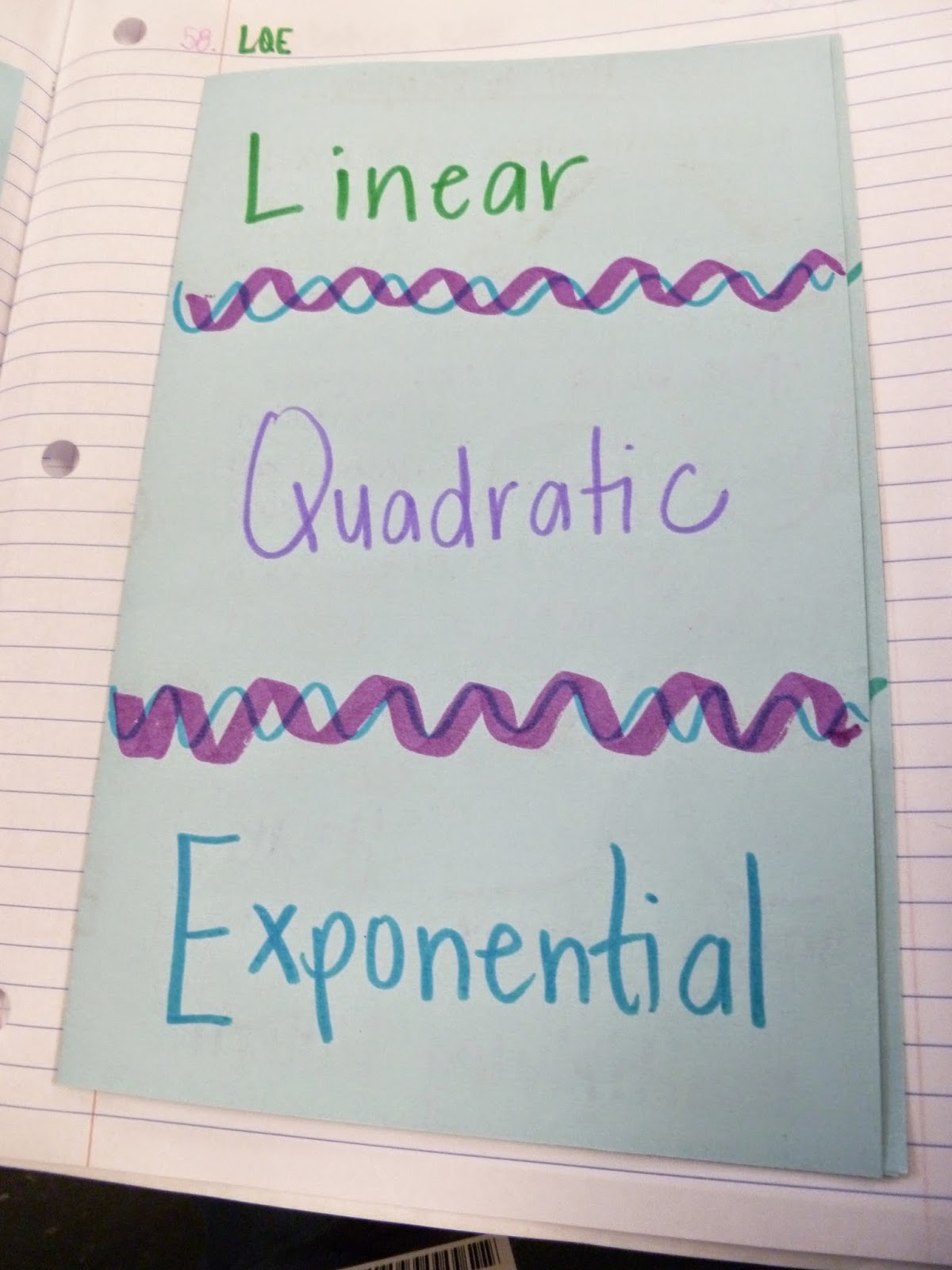
Friday Freebies! Comparing Linear/Quadratic/Exponential Functions

My students are testing today on the unit we introduced with Zombie Day. 


We used a "Fun with Functions" Cut and sort activity to practice identifying/classifying LQE functions.
 We spent plenty of time working with multiple representations of each, and how to write the equation for a function once you know what type it is.

Then we moved on to translating, with matchbook notes. 


And after seeing this blog post from Math=Love, we included a drawing of our calculator yesterday when talking about using the regression functions on our Ti-84s. 

And we practiced, and practiced, and practiced. 
We did a scavenger hunt.


We used LQE cards on the 2nd day of the unit for whole-class response practice. 

The following day, we increased the level of difficulty by using cards that said what type of L,Q, or E each example was. (The exponential card had decay on one side, growth on the other)

I wanted to do so much more with this unit, but there's only so many days left until testing season begins.
However, I do think that having a day of centers would have been better than only doing the practice in mostly whole-class settings. So I made a card sort for this unit (using this 12-block template) - we'll use it for EOC review. I wrote up the process for using a similar 9-block template in this previous post.


Here are some of the ways I'm thinking of using the LQE cards (it's a set of 48)
  • printed 2 to a page, into a column sort in their ISN
  • printed onto cardstock, used as Go-Fish or Memory (each exponential matches with any other exponential)
  • printed onto cardstock, used as a center matching activity (3-column sort as a group onto a posterboard or table marked with 3 sections)
  • center activity where students play Left-Center-Right, but to keep/receive a card, they say L/Q/E
Start the download for the card set by clicking here. It's a Word docx file, so feel free to edit it to suit your students' needs. 

Have a great weekend!