Showing posts with label LQE. Show all posts

Friday, May 2, 2014

Friday Freebies! Comparing Linear/Quadratic/Exponential Functions

My students are testing today on the unit we introduced with Zombie Day. 


We used a "Fun with Functions" Cut and sort activity to practice identifying/classifying LQE functions.
 We spent plenty of time working with multiple representations of each, and how to write the equation for a function once you know what type it is.

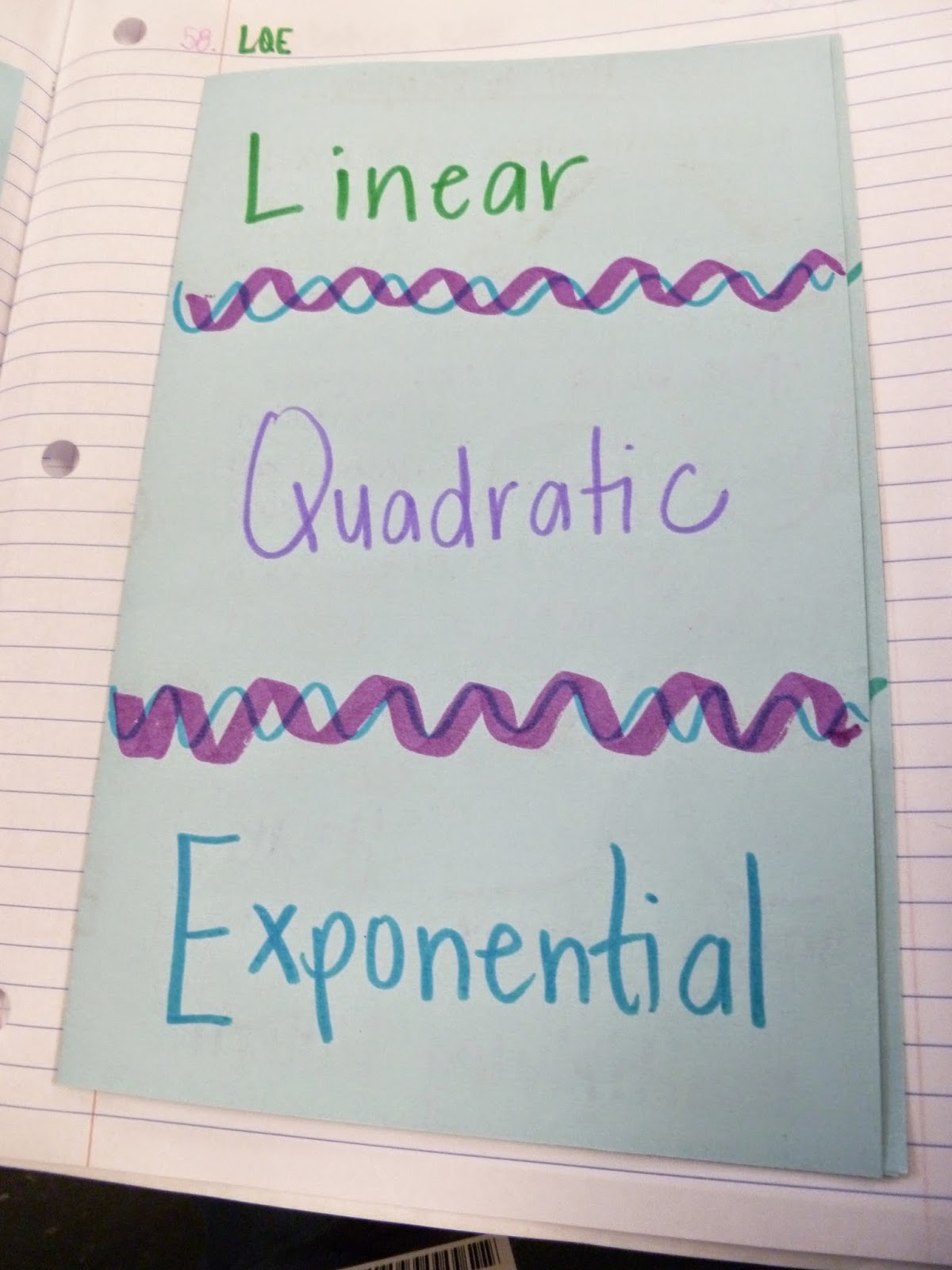
Then we moved on to translating, with matchbook notes. 


And after seeing this blog post from Math=Love, we included a drawing of our calculator yesterday when talking about using the regression functions on our Ti-84s. 

And we practiced, and practiced, and practiced. 
We did a scavenger hunt.


We used LQE cards on the 2nd day of the unit for whole-class response practice. 

The following day, we increased the level of difficulty by using cards that said what type of L,Q, or E each example was. (The exponential card had decay on one side, growth on the other)

I wanted to do so much more with this unit, but there's only so many days left until testing season begins.
However, I do think that having a day of centers would have been better than only doing the practice in mostly whole-class settings. So I made a card sort for this unit (using this 12-block template) - we'll use it for EOC review. I wrote up the process for using a similar 9-block template in this previous post.


Here are some of the ways I'm thinking of using the LQE cards (it's a set of 48)
  • printed 2 to a page, into a column sort in their ISN
  • printed onto cardstock, used as Go-Fish or Memory (each exponential matches with any other exponential)
  • printed onto cardstock, used as a center matching activity (3-column sort as a group onto a posterboard or table marked with 3 sections)
  • center activity where students play Left-Center-Right, but to keep/receive a card, they say L/Q/E
Start the download for the card set by clicking here. It's a Word docx file, so feel free to edit it to suit your students' needs. 

Have a great weekend!

Tuesday, April 29, 2014

Zombie Outbreak!

One of the topics I've started teaching since NC started Common Core is comparing linear/quadratic/exponential functions. Two semesters ago, I saw this blog post where a teacher had used zombie outbreaks to have students explore exponential growth.

I switched up the lesson plan a bit, and we did 3 rounds of "zombie outbreaks" in my class, each with a different soundtrack. At this point in the semester, we've learned about linear, quadratic, and exponential functions. However, I don't tell my students which outbreak is which until we're done.

For each round, students meander around the room, and my "patient zero" student follows the rules for that round by infecting students in a certain way. (Infections are stickers on their hands). As we listen to the music, I announce every 15 seconds "End of day __, Wake up, everyone! It's the morning of day ___!" I make a big deal of everyone "freezing" at the end of the day to "sleep," and then we resume movement with waking up on the next day.


  • Round 1: (Linear) Each day, the zombie "infects" 3 new people, but the new zombies cannot infect anyone.
  • Round 2: (Quadratic) Each day, the zombie learns how to infect an additional 2 people per day (I tell them the zombie is learning to run faster each day, and so the first day is still 3 people, but then 5, 7, and so on). New zombies still cannot infect anyone.
  • Round 3: (Exponential) Each day, every zombie is able to infect 1 person. New zombies have infection powers.


It's so funny to watch them play this - I always have a couple students that want to be infected, and a couple that don't, and run away from the zombie. The game usually turns into a mild game of tag/hide-and-seek.
Once infected, the students have to "report their infection to the CDC," which means dragging a picture of a person on the SMARTboard into a box for day 1, 2, 3, 4, 5, or 6. (whichever day they got infected).


Once the rounds are complete, we record our findings in our ISNs, and discuss what patterns we see. Usually my students identify round 1 and 3 almost immediately as linear and exponential. I also usually have 1-2 students that see the square number pattern as well, which leads us to label round 2 as quadratic.


We discuss the characteristics of each function that we remember (this is a great review right after spring break), and then write the equation for each round. Then we destroy the world. :)

They research in groups online to find the population of our school, city, county, state, country, continent, and the world. Then they solve for round 1 and 2 how many days it would take to infect that population. They use a guess and check method for exponentials, since Math 1 kids don't learn logs until next year.


Things I want to improve in the future:

  • predictions about each round before we start (I want them to discuss which scenario will infect the most people in a week, in a year, etc.)
  • "CDC Disaster Reports" as a lesson conclusion (I'd love each group to take 1 time period, maybe a week, 1 month, 6 months, 1 year, and write up the infection rate based on each scenario)